

[Campus] New Chance for Students: Expanded Grade-eraser Policy Begins This Fall
Kyung Hee University (KHU) will expand its grade-eraser policy starting in the second semester of 2026, letting eligible students remove up to six credits from their GPA. The General Student Associations (GSA) of KHU’s Seoul and Global campuses confirmed the expansion, temporarily called the “Grade Eraser,” after a survey of 3,822 students showed strong demand for it. Choi Ji-hyun, secretary-general of the Committee for Campus Self-governance of Seoul GSA, provided most of the details on how the program will work. It will cover nearly every course, a wider scope than first planned, and the real question now is how much it will actually help.
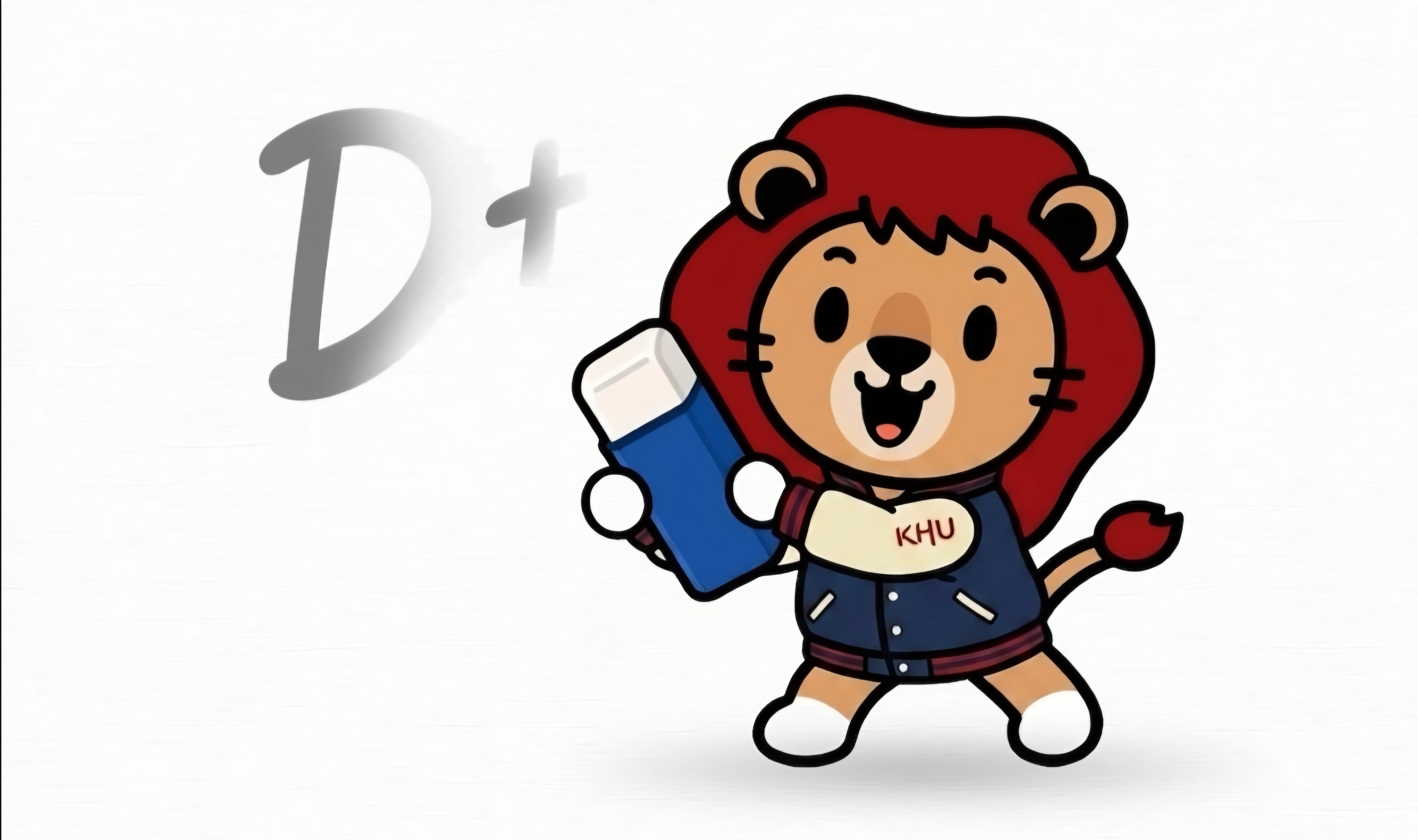
KHU mascot KHU-on erasing a grade mark
Photo: GSA Instagram (@khu_58_mate, @khu_58_route)
What is Changing
Students can “erase” up to six credits total before graduation, removing those grades from their GPA calculation. Choi said 45.9% of survey respondents picked six credits as the right cap, since it can typically cover two courses—enough to meaningfully impact a GPA, without inviting grade inflation.
Students must be enrolled and have completed at least seven semesters to apply. Students with delayed graduation still qualify. Choi said the GSA set that cutoff deliberately, timing it just before a student’s final semester to discourage early or careless use. The numbers track each program’s length: seven semesters for a standard four-year degree, 11 for the six-year medicine and pharmacy tracks, and nine for the five-year architecture program.
Students on leave, those who have finished coursework but not graduated, students with delayed degree conferral, and graduates cannot apply. Nearly all courses qualify, including required major and general-education classes. The exceptions are credits transferred in from another school and Pass/Fail courses where the student passed.
Retaking a erased course counts as a normal retake. Choi said the transcript mark for the original semester changes from W (withdrawal) to WR (withdrawal / Retake), combining the erased and retake marks, while the new grade appears separately on the semester it was earned. If the forgiven course was required for graduation, the student must retake it before graduating. Once a grade is forgiven, it can never be restored.
Two other things stay unaffected: The yearly credit-registration limit, still based on credits earned before forgiveness, and a student’s academic probation status. Award selection and scholarship decisions also still use pre-forgiveness grades. That detail caused some confusion, since the original agreement had listed “scholarship calculation” specifically, but the recent announcement mentioned only “award selection.” Choi confirmed scholarships follow the same rule, adding that the point is to keep students who use the program from gaining an unfair edge over those who earned good grades everywhere without it. Because the W mark stays on the transcript, the record is not actually erased, despite the policy’s name.
Why the Program Expanded
The push traces back to KHU’s stricter retake rules, which took effect in the first semester of 2026 and cut students’ chances to fix bad grades, Choi said. A new requirement for incoming students to complete a double major or minor added academic risk without much of a safety net, she said, and some students found retaking a course simply impossible when a professor retired or a class was not offered again. With Korea University and Hanyang University already running larger versions of the program in 2023 and 2025, Choi said KHU risked leaving its own students less competitive for jobs and graduate programs, including Law School.
Winning over the administration took work. Officials initially raised concerns about grade inflation, damage to the university’s academic reputation, and students taking classes less seriously. Rather than pitching something new, the GSA framed the plan as fixing gaps in the existing system. It submitted a 30-page proposal built on the student survey, examples from other universities, and the Ministry of Education’s push for more flexible policies. The GSA then met roughly every two weeks with the director and vice-president of academic affairs. Choi said the GSA repeated one message throughout: This was not grade laundering, but a safety net for students willing to take on tough challenges.
According to Choi, an earlier draft would have excluded required major and general-education courses to ease the administration’s workload. The GSA pushed back, arguing that limiting the program to electives would make it far less useful for students exploring difficult subjects. The administration eventually agreed to expand coverage to every course.
Once that was settled, the GSA pushed to lock in a fall 2026 start so no student would miss out over a single semester’s gap, Choi said. Waiting, risked leaving students who graduated in between with no benefit at all. “We talked with the University Administration with the urgent feeling that if we could not make this happen this semester, there would not be a next chance,” Choi said.
The C- grade being erased
Photo: GSA Instagram (@khu_58_mate, @khu_58_route)
Questions Remain
Grade-eraser policies have a mixed record elsewhere. Past versions were criticized in National Assembly audits for enabling grade laundering, and several universities responded by shrinking or ending them. KHU’s version includes safeguards: The six credit cap, the rule against restoring forgiven grades, and the use of pre-forgiveness grades for awards and scholarships, though whether they are enough remains an open question.
Fairness is a separate concern. The program isn’t retroactive, so students who graduated or finished their coursework just before the launch get nothing, even though they faced the same stricter retake rules current students did. Eligibility also kicks in at different points depending on a student’s program, since the eligible semester thresholds vary.
“That feels like it goes against fairness, and that’s disappointing,” said Lee Hee-man, a student in the Dept. of Industrial and Management Systems Engineering. “I understand it is probably unavoidable given the school’s administrative situation, but being left out of the benefit by just one class year is bound to create a sense of relative deprivation. I wish they had publicized the program further in advance and given students a grace period to prepare.”
Beyond questions of fairness, the program could also affect how students approach difficult courses. Kong I-seo, a student in the Dept. of Global Communication, said the program could have a significant effect on students’ attitudes toward difficult courses. Students may be more tempted to give up on a difficult class and erase the grade rather than push through it, potentially affecting the classroom environment. At the same time, Kong said the program could encourage students to take courses they might otherwise avoid because of concerns about their grades. Kong suggested that this could also help ease enrollment concentration in certain courses.
The program’s safeties may also affect how students view its overall effectiveness. Kong said they were not previously aware that original grades would still be used for scholarship and award decisions, but considered the rule reasonable. Given the concerns about fairness, Kong said it would be appropriate to monitor the effects of the program before making further changes.
What Comes Next
Choi said the GSA will keep gathering feedback through campus booths and an online form. Separately, the Committee for Campus Self-governance said it is working with the KHU International Students’ Association on a survey and card-news content aimed specifically at international students. The program’s real impact will become clearer once students start applying this fall. How many apply, which courses they erase most often, and whether GPA patterns shift will show how the policy plays out in practice.
There are no registered comments.
- 1
- 2
- 3
- 4
- 5


I agree to the collection of personal information. [view]