

[Feature] Scrolling Into Politics: How Social Media Is Reshaping Youth Political Participation
When was the last time you actually searched for political news? For many young people, the honest answer is: rarely. It just shows up, sandwiched between a friend's brunch photo and a skincare ad, uninvited but impossible to ignore.
That is politics now: not something chased down, but something that arrives on its own, wedged between the mundane and the personal. Social media has changed how young people encounter political information: faster, more constant, and harder to opt out of. But a harder question follows: Whether that constant exposure turns into real participation, or just deepens the divisions already there.
A New Gateway to Political News
Ahn Sun-you, a Kyung Hee University (KHU) student majoring in international studies, follows outlets such as CNN, The New York Times, Reuters and the BBC on Instagram. Political reels and posts beyond those accounts also enter her feed, exposing her to information she did not seek out.
She is far from alone. According to the Korea Press Foundation's 2024 Social Media Users Survey, more than 80 percent of South Koreans in their 20s use Instagram, and one in three get news through social media.
Kim Min-seo, a second-year KHU student majoring in international studies, gets political news through online articles for factual information, and through social media, which she finds more accessible. "Usually I think it just pops up on my algorithm once in a while, especially news that has a lot of controversy or is going viral," she said. Kim Hyo-rin, a KHU student majoring in global communications, said she rarely seeks out political news: it "just appears everywhere," in the news, on Instagram, even "subtly in advertisements."
Professor Go Min-hee of Ewha Womans University's Dept. of Political Science and International Relations says political participation is diversifying beyond offline action, pointing to two trends: non-political content such as memes becoming politicized, and political content spreading through accessible formats like short-form video.
From Clicks to Collective Action
Social media has transformed not only how the public consumes political information, but also how collective opinion is formed. The #MeToo movement is a prime example, with hashtags becoming tools for survivors and allies to share their experiences and raise global awareness of sexual abuse.
South Korea's Nth Room case also illustrates the power of digital activism. After investigators uncovered a network of digital sexual exploitation involving over 1,100 victims, many of them minors, public outrage moved online. According to Human Rights Watch, a petition demanding action gathered more than 2.6 million signatures within a month, contributing to the 2020 revision of the country's sexual exploitation laws.
Prof. Go points to such movements as evidence that online participation can extend beyond symbolic gestures: "Topics that were difficult to represent through existing channels like #MeToo and #WithYou spread through online platforms and have already brought about real policy and social change," she said.
During the declaration of martial law in December 2024, activism quickly shifted online through a digital candlelight map that visualized public resistance. According to Korea JoongAng Daily, images of candles and calls for impeachment spread across social media, helping people coordinate beyond physical protest spaces. This shows how digital spaces could quickly mobilize engagement during a crisis.
Validation Online, Votes Offline
Convenience is not the only reason young people participate online; people also engage more when political discussion feels meaningful. In Antecedents of Political Participation through Social Network Service (SNS): Moderating Effects of Political Orientation, Prof. Yoon Byung-sup of Public Administration of Anyang University found that political efficacy, the belief that one's opinions can influence society, increases the likelihood of online participation.
The June 2025 presidential election showed this dynamic play out. As campaign videos, debate clips and political hashtags became a constant part of young people's feeds, turnout among voters in their 20s rose compared with the previous election. According to National Election Commission data, turnout among men aged 20 to 24 climbed from 70.0 to 72.7%, and among women 20 to 24 from 73.4 to 77.7%, with similar gains for those in their late 20s. Overall turnout reached its highest level in nearly three decades, at 79.4%.
The pattern is consistent with the idea that greater political engagement online can encourage participation offline. Still, the election data alone cannot show that social media exposure or online political discussion caused the increase in turnout; other factors may also have contributed.

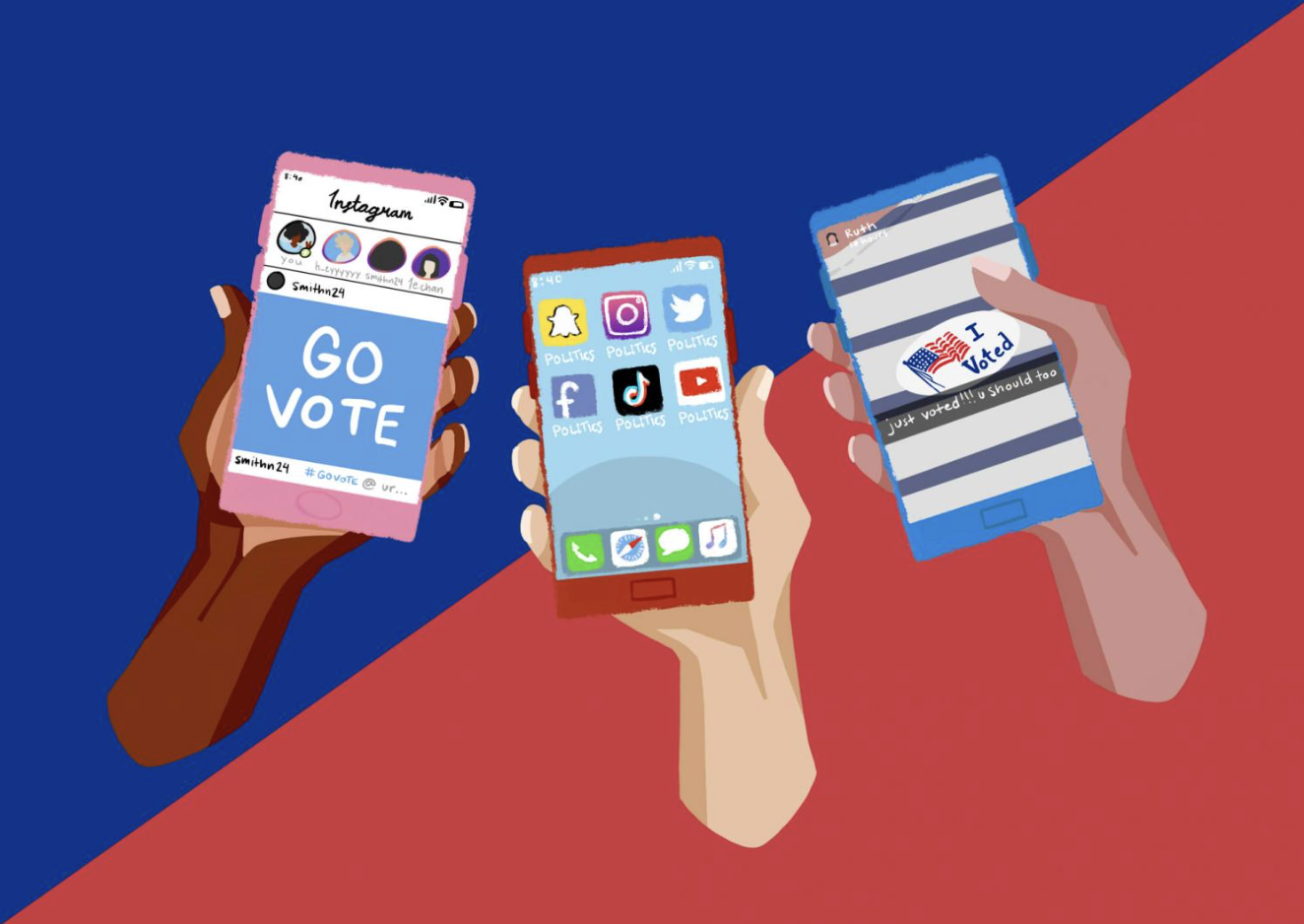
Social media and political participation
Photo: The Evergreen Online (evergreen.greenhill.org)
The Dark Side of Digital Participation
Not all researchers are convinced online enthusiasm translates into meaningful participation. Critics point to "clicktivism," low-effort actions like liking, sharing, or signing petitions, questioning whether such actions produce lasting change.
Prof. Lee Jae-mok of Hankuk University of Foreign Studies argues that realizing the value of online participation requires more than sharing a post. Political interest is valuable in itself, he says, but the deeper question is "whether that interest remains mere curiosity, or actually translates into participation." Short-form content is only a gateway if users move beyond passive consumption to fact-check sources.
Ahn takes a similarly cautious view: posting something that "required only a few clicks and took only a few seconds" is not meaningful participation, she said. However, Kim Hyo-rin sees it differently. She's never posted or commented on political content, describing herself as someone who mostly "watches, likes or scrolls," but still sees social media as meaningful, "one of the most accessible forms of participation where anyone can express their opinion." Even a small posted opinion, she believes, can contribute to wider discourse.
Prof. Choi Young-jae's research, The Social Media's Effect on Political Participation, adds a complication: once ideology and efficacy are accounted for, the link between social media use and voting weakens, suggesting it makes already-engaged people more visible rather than creating new participants.
That same ease of sharing is exactly what let misinformation travel fast after South Korea's June 3, 2026 local elections. A map began circulating on X claiming voter turnout had topped 100 percent in several Jeonbuk State's counties, the kind of number that makes users pause their scrolling and demands a screenshot. According to a 2026 AFP fact-check, the map traced back to PoliMap, a civic platform that publishes election-data visualizations; PoliMap later admitted a calculation error had counted some early votes twice. The real numbers told a much less dramatic story: no county came close to 100 percent, and the highest, Sunchang County, sat at 79.9 percent. But by the time that correction caught up, the map had already done its damage, another reminder that a mistake can travel faster than the fact-check meant to catch it.
The problem is not only that false information can spread quickly, but that contentious political content can also keep people engaged. A 2025 study of millions of Naver News comments from the 2022 presidential election by Sungkyunkwan University's Ryu Hyo-sun and Lee Jae-kook found that hostile comments often attracted attention even after being criticized, prolonging online arguments rather than resolving them.The finding suggests that online political spaces can reward conflict with continued attention, making disagreement harder to move past.
Prof. Kang Jin-suk of Chung-Ang University's School of Media and Communication argues misinformation is not a problem affecting young people alone: Older adults encounter false information through group chats, while younger users face risks from AI-generated images and voice manipulation. "The problem of false or manipulated information cuts across generations," she said.
Algorithms and Echo Chambers
Platform algorithms can compound the problem by shaping which political information users encounter. Recommendation systems use users' previous activity to determine what content to show them, meaning people may repeatedly encounter information similar to what they have already engaged with. Over time, this can create an environment where familiar views are reinforced while opposing perspectives appear less often.
Students described this firsthand. "My social media feed is mostly inclined toward what I agree with," said Ahn, who noted that algorithms can leave users "fragmented as a whole society." Kim Hyo-rin also said, "Echo chambers and confirmation bias, that's nothing new to me," adding that she relies on "reputable newspapers or academic essays" to get information beyond what appears on her social media feeds.
A New Regulatory Response
South Korea has also begun responding at the policy level. The revised Information and Communications Network Act, effective July 7, 2026, addresses "false or manipulated information." Under Article 44-7, it prohibits distributing such information under specified conditions; under Article 44-24, regulators may fine repeat distributors up to one billion won. Prof. Kang said the law is one part of a broader response, but regulation alone cannot solve the problem; media and AI literacy education is also needed so users can understand recommendation systems and recognize manipulated content.
More Than Just Participation
Easy access to politics does not ensure meaningful participation. For Ahn, participation requires more than a few clicks; for Kim Hyo-rin, even a small opinion can contribute to discourse. What happens after the scroll may matter more than the scroll itself.
With greater access to political discussion also comes greater responsibility to check information and engage thoughtfully.
There are no registered comments.
- 1
- 2
- 3
- 4
- 5



I agree to the collection of personal information. [view]