

[Campus] Reconsidering the Meaning of University Festivals
About this year's festival
● 2025-2 MASTERPEACE: Moments of Holiday
Festivals are always a hot topic in university life—but not always for the right reasons. This semester’s festival at Kyung Hee University (KHU) Seoul Campus was no exception. If anything, the star-studded celebrity lineup made the arguments more controversial.
Access, Crowds, and the Question of “Who Is It For?”
For many students, the lineup of celebrities performing at festivals has become the main way to judge the General Student Association (GSA). Other pledges and efforts of GSA often fade into the background, while a few Instagram posts announcing singers and idols seem to define the GSA’s entire year. The phrase “GSA only for festivals” now circulates casually among students, reflecting their growing indifference toward student governance. We have reached the point where it feels as if the GSA exists only to host one big concert.
The festival is also connected to the local community. In the past, KHU operated a “free zone” that allowed non-KHU visitors to enter the Amphitheater in the name of coexistence with the local community. However, problems soon emerged: idol fans camping overnight, entrance wristbands being traded, and piles of trash left behind. As a result, the free zone was abolished from the Fall 2024 semester.
Even after that change, problems did not disappear. People still lined up overnight, trash remained a problem, and the resale price of KHU student IDs online soared. The GSA started to check student IDs more strictly to block outsiders who pretended to be students, which resulted in entry delays. Many students could not enter even after the main performance started. A festival meant “for KHU students only” ended up shutting out the very students it claimed to prioritize. We must ask: for whom is the festival really for?
From Daedongje to Idol Stages: How We Got Here
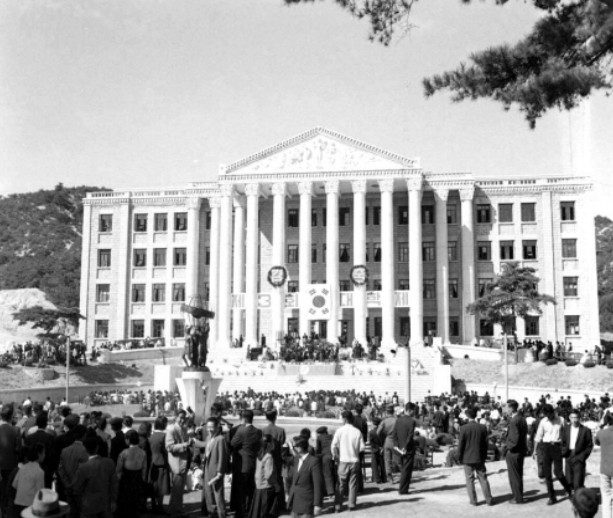
The Third Festival Held at KHU (Former Shinheung Military Academy)
Photo: National Archives (theme.archives.go.kr)
To answer that, it is worth looking back at the origins of university festivals. KHU is often considered the birthplace of the modern Korean university festival. In 1956, KHU’s precursor, the Shinheung Military Academy, hosted its first event centered on student-driven programs such as theater, music, sports, and mock trials. The term Daedongje, now widely used to refer to Korean university festivals, grew out of the student democracy movement in the 1980s. Meaning “great unity,” it was first Korea University in 1984 to bridge the divisions between student groups. The idea soon spread to other campuses.
Rethinking What a Festival Should Do
Now, however, a name that once symbolized unity is often treated like a brand for celebrity concerts. Going back to a celebrity-free festival is neither realistic nor necessary. Times change, and festivals evolve with them. However, large budgets, long planning hours, and huge volunteer efforts are invested into these events. At this point, we need to stop and ask: what is the essence of the festival that students so eagerly anticipate? If we are going to invest this much in it, shouldn’t it offer more than just a chance to see celebrities up close?
Festivals are not merely concerts. They can be one of the few times when the campus feels like a shared space again. In an age when university life is increasingly individual, festivals can remind us that we belong to a community. Recalling the original spirit of Daedongje, the festival can become an opportunity for Kyung Hee students and local residents to come together. Beyond the spectacle on stage, rediscovering the value of connection may give university festivals a more enduring meaning.
There are no registered comments.
I agree to the collection of personal information. [view]