

[Campus] Peace BAR Festival: a Four-day Festival Asks Whether Humanity Can Still Choose Peace Over Collapse
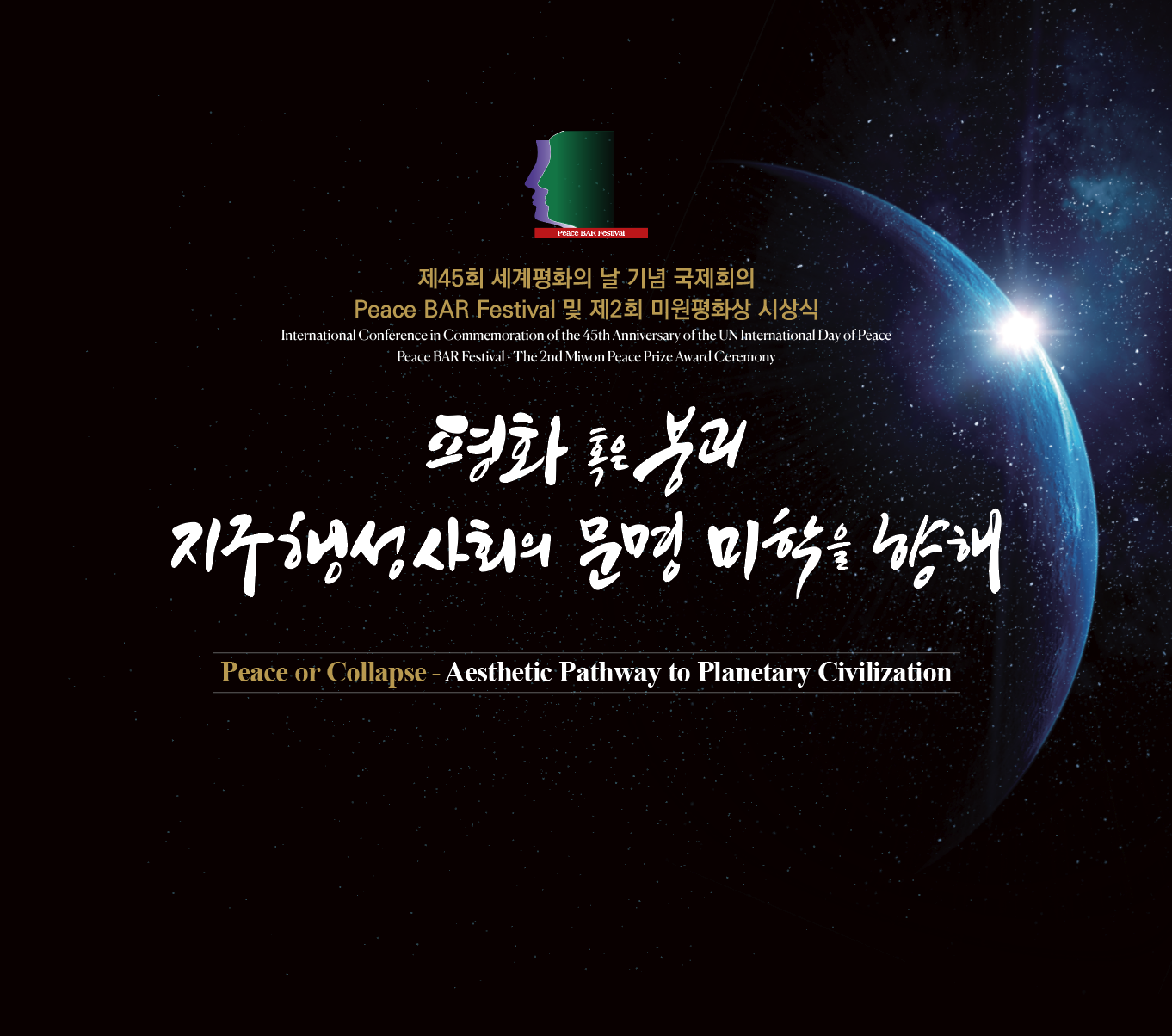
The 2026 Peace BAR Festival (PBF) will run for four days, from Saturday, September 19 through Tuesday, September 22, at Kyung Hee University's (KHU) Grand Peace Hall and Cheongwoon Building. Hosted by the Kyung Hee Educational Foundation, this year’s festival is jointly convened by several Kyung Hee affiliates, including Miwon Institute of International Relations and the Global Academy for Future Civilization (GAFC). Under the banner “Peace or Collapse: Aesthetic Pathway to Planetary Civilization,” PBF 2026 will open a public square asking where human civilisation is headed at this critical moment.

The 2026 Peace BAR Festival: Peace or Collapse - Aesthetic Pathway to Planetary Civilization
A 45-Year Lineage, and the Weight of This Year
PBF is an annual event held to commemorate the UN International Day of Peace on September 21. Its history goes back to 1981, when the UN General Assembly established the UN International Day of Peace at the proposal of the late Dr. Choue Young-seek, the founder of KHU. The acronym “BAR” carries a long-standing philosophy: a global community that is spiritually Beautiful, materially Affluent, and humanly Rewarding.
This year marks the 45th anniversary of the UN International Day of Peace. To match that historical weight, the organizing committee has placed “holistic reflection” at the center of this year's theme. This serves as an appeal for deeper thought about how to overcome today's multifaceted crises. The committee reasons that life, nature, technology, and civilization are all closely interconnected in a planetary society. Therefore, rather than focusing on a single problem, we must search for answers to humanity's crises from a wider view.
|
Adding to that symbolism is the second Miwon Peace Prize, which was established last year to honour those devoted to a better human condition and the future of peace. This year's prize will go to the Bulletin of the Atomic Scientists. Through its Doomsday Clock, this US-based publication has continuously warned of existential threats to humanity, including nuclear war, climate change, and artificial intelligence. The selection was made by a jury that included Avi Loeb, professor of astronomy at Harvard University, and G. John Ikenberry, professor of international politics at Princeton University; the Bulletin of the Atomic Scientists was chosen in recognition of its long-standing contribution to international peace. |

The doomsday Clock from the Bulletin of the Atomic Scientists
The core of this festival lies in integrating the two events with this year’s main theme. The GAFC explained, “Our greatest focus for this festival was weaving three main pillars—the 45th UN International Day of Peace, the 2nd Miwon Peace Prize, and this year’s PBF theme, 'Peace or Collapse'—into a single, cohesive flow.” They added, “Amidst the complex crises facing humanity today, we wanted to reflect together on what kind of peace we should strive to build.”
Where Scholarship Meets Citizens—From Colloquium to Round Table
The festival opens with academic discourse. On Saturday, September 19 at 10:30 a.m. in Cheongwoon Building Room B117, the first colloquium will be held. Moderated by Ahn Byung-jin, a professor at the KHU GAFC, the session will hold a discussion under the title of “Pathway to Planetary Citizenship and Engagement.” The keynote speakers are Kang Kum-sil, Ambassador for Climate and Environment; Lee Sung-hoon, Ambassador for Human Rights, Peace, and Democracy; and Kim Sung-kon, chair of the Korean organizing committee for the UN International Day of Peace. Lee Woo-kyun, president of SDSN Korea will also present, illuminating issues of climate, human rights, and civil society from the perspective of planetary peace.
The colloquium is a key session highly recommended by the organizers, which will provide a forum for experts and student representatives to question the role of citizens today. The GAFC stated, “It will be an opportunity to reflect on our responsibilities and actions from the perspective of a ‘planetary citizen,’ transcending the boundaries of nation and society.
On Sunday, September 20, a special lecture on “The Search for Extraterrestrial Intelligence and the Future of Humanity” will follow. Led by Prof. Avi Loeb, this lecture will pose questions about whether humanity is truly alone in the vast universe and how human civilization should understand itself based on that answer.
The intellectual peak of the discourse comes on Monday, September 21 at 10 a.m. in Cheongwoon Hall Room B117, with the round table. This year's topic is “Breakthrough or Breakdown: Pathway to Planetary Peace.” Daniel Holz at the Bulletin of the Atomic Scientists will lead the discussion. He will be joined by a panel of global scholars: Daniel Holz, chair of the Science and Security Board at the Bulletin of the Atomic Scientists, joined by Paul Shrivastava, co-president of the Club of Rome; G. John Ikenberrn at Princeton University's School; Mirian Vilela at the Earth Charter International; and Yokoi Atsufumi at Okayama University. Together, these leading scholars will explore what a way out of the civilisational crisis might actually look like.
Where Ceremony, Prize, and Art Converge, and the Dialogue Opens Up
On the afternoon of September 21, the festival's central events will unfold. At 2:30 p.m., the 45th-anniversary ceremony of the UN International Day of Peace will begin. California State Senator Choi Suk-ho will serve as the master of ceremonies, who will revolve around the core message of “New Conditions, Strategies and Creative Futures for Peace.” The event will also feature a congratulatory video message from former UN Secretary-General Ban Ki-moon.
Various events will follow. At 3 p.m., the second Miwon Peace Prize will be conferred on the Bulletin of the Atomic Scientists. Immediately afterward, Choue Inwon, chairman of the Kyung Hee Educational Foundation, and Daniel Holz will hold a commemorative dialogue on the theme “In Search of Planetary Aesthetics.” The conversation is expected to look at the crisis of human civilisation through a cosmic and philosophical lens, asking what a practical aesthetics of peace might mean.
That evening, the discourse on peace moves onto an artistic stage. At 7:30 p.m. at the Grand Peace Hall, a peace concert titled “Lovers of Paris in Kyung Hee: 1.5°C of Love” will be held. Taking the 1.5°C target of the Paris Climate Agreement as its motif, the concert will translate the climate crisis and the human bonds into stage art.

Peace Concert Commemorating the 2nd Miwon Peace Prize Award Ceremony
On the festival's final day, Tuesday, September 22, two dialogue programmes will bring the event to a close. First, in the “Intergenerational Dialogue,” Daniel Holz and other international scholars will discuss the future of the planet together with the next generation. This will be followed by the “Interfaith Dialogue,” in which religious and civil-society leaders will explore the universal values of peace. Spanning scholarship and citizenship, generations and faiths, these two programs will end the festival with open-ended reflection.
Regarding the overall event, the GAFC expressed hope that it will connect seemingly distant topics of humanity's future directly to individual lives. They added, “Even if you do not find a grand solution, simply walking away with one new question through the lectures, dialogues, and small acts of participation will be meaningful enough.”
This year's PBF will carry its four-day journey from academic discourse through artistic expression into a cross-generational and cross-faith dialogue. Through this festival, KHU will illuminate the compound crises humanity faces under a single, holistic light. Before the heavy question of “peace or collapse,” PBF will serve as a meaningful public square for shaping answers toward a sustainable future.
There are no registered comments.
- 1
- 2
- 3
- 4
- 5


I agree to the collection of personal information. [view]