

[Feature] From Verbs to Reflection: Reading the Classics with Sentence Lesson
[Related articles]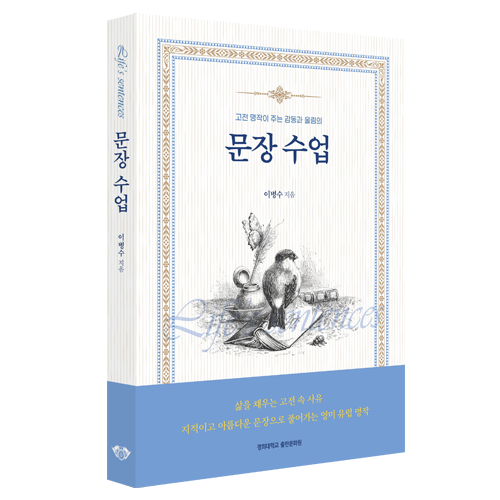
Sentence Lesson
Photo: KHU Press & Communication (khupress.com)
What is the true meaning
of reading the classics—an endeavor akin to interpreting the universe? On July
10, Kyung Hee University Communication & Press published Sentence Lesson,
a new book by Professor Lee Byung-soo of Humanitas College. Serving as a sequel
to his previous work Verb Lesson, this book explores the dark emotions
and human nature through classic literature, offering readers a new space for
reflection.
Finding Guidance Through
Life’s Hardships with Facing Inner Shadows
Sentence Lesson was designed to promote
the value of reading classics while helping readers gain a deeper understanding
of challenging literary works. Prof. Lee highlighted the practical
difficulties, stating, "Reading the classics is essential to enriching
life regardless of time or place, but advanced reading—which involves grasping
various backgrounds and contexts within a work while staying engaged—is by no
means easy for students or the general public." The book therefore aims to
make this kind of advanced reading more accessible to students and general
readers.
With this challenge in
mind, Sentence Lesson takes a different approach from his previous book, Verb
Lesson, which shed light on the bright and positive aspects of humanity
through the classics. This new work instead focuses on complex and dark
emotions such as anxiety, desire, and jealousy. Prof. Lee explained the reason
for this focus: "Our lives are not always happy, and life is a continuous
journey of navigating the high and low waves of misfortune." The book aims
to help readers project themselves into the despairing moments experienced by
literary characters such as poverty, separation, sin, and death. In doing so,
readers can find practical guidance for overcoming present difficulties and moving
toward a better tomorrow.
The Appeal of Reading
Classics Through Verbs
The most distinctive
aspect of this book is that it approaches 18 masterpieces of British, American,
and European literature by matching them with specific verbs such as "to
choose," "to envy," and "to confess." Prof. Lee
explained, "Because the themes and lessons conveyed by authors differ and
each reader feels differently, readers sometimes lose sight of what they should
actually focus on among the vast storylines in a book of several hundred
pages." In other words, this reading method uses a single verb as a
central theme, helping readers avoid getting lost in lengthy classic works and
instead focus more closely on thought and contemplation.
For example, Gustave Flaubert's
Madame Bovary, which Prof. Lee cited as the work that resonated most
deeply with him while writing, is read through the lens of "to
desire." Rather than attributing the protagonist’s tragic end simply to
failed love, the book focuses on financial ruin brought on by endless vanity
and uncontrolled “desire.” In doing so, it highlights the painful consequences
of allowing desire to grow unchecked.
Reading, Reflecting, and
the Role of the Humanities in the AI Era
Reading the classics,
Prof. Lee argues, is an act of interpreting the world. In discussing Umberto
Eco’s The Name of the Rose through the verb “to read,” he cited the
phrase, “To read is to interpret the universe.” He explained that reading goes
beyond merely understanding written text and involves contemplating the
principles of all creation and the order of the universe. Prof. Lee views this
capacity for interpretation and reflection as especially important for people
living in the artificial intelligence (AI) era. He stressed that as AI
increasingly produces information on our behalf, what people need is not
shallow information but “deeper reflection.” Referring to Philosopher’s Square,
also known as Pensées Plaza, on the Global Campus, he added that human beings
are inherently contemplative and that technology without humanistic imagination
risks becoming merely a tool for capital.
Ultimately, Sentence
Lesson serves as a guide to confronting human vulnerabilities and inner
shadows through the unique lens of "verbs," helping readers navigate complex
classical works while developing the capacity for deep thought that is
increasingly important in the AI era. Prof. Lee expressed his hope that
students would use Verb Lesson and Sentence Lesson as personal
compasses to "discover good books meaningful to themselves, follow
high-quality prose, and enjoy moments of deep and joyful reflection."
Beyond a simple literary guide, Sentence Lesson serves as a timely
reminder of the enduring power of the humanities—offering young minds a quiet moment
to pause, reflect on themselves, and cultivate the inner strength needed to
navigate an ever-changing world.
There are no registered comments.
- 1
- 2
- 3
- 4
- 5



I agree to the collection of personal information. [view]