
[Feature] The Two Sides of Stock Investing: How Should Gen Z Invest for the Future?

The KOSPI index, dollar exchange rate, and KOSDAQ index are displayed in a dealing room Photo: The MBC news (imnews.imbc.com)
After the pandemic, more young people have increasingly turned to stocks and cryptocurrencies as part of their wealth-building strategies. For them, checking stock prices and sharing investmentrelated information have become part of daily life. Nonetheless, this growing investing enthusiasm has also raised concerns, especially as young investors use high-risk leveraged trading in pursuit of fast profits.
Investing Becomes Part of Student Culture
Nowadays, Gen Z checks stock prices almost as often as social media feeds. Investing is no longer viewed as a distant financial activity. Lee Sang- myung, a student from Kyung Hee University’s Dept. of Philosophy, described how common investing culture has become among students. “Stocks are now a common topic of con- versation,” he said. “I have seen friends who are interested in stocks watching financial broadcasts together.”
Students are also learning about the market in new ways compared to older generations. Many rely on YouTube content, online communities, and investment clubs to study stock trends and share information with one another. Another indication of this trend is the growing popularity of stock investment clubs on university campuses. According to ABS, Kyung Hee University’s stock investment club, the number of applicants has continued to increase regardless of prior experience or major, reflecting the growing desire among students to better understand investing and financial decision-making.
Companies have also recognized this growing investment culture, with organizations such as the Korea Economic Daily supporting university investment competitions through clubs like ABS.
Recent data shows how rapidly this trend has expanded. According to the Korea Capital Market Institute (KCMI) report titled Financial Asset Formation Among Young Adults in Korea: Recent Trends and Policy Implications, the proportion of stocks, funds, and bonds held by households in their 20s and 30s increased from around 20% before the COVID-19 pandemic to nearly 40% afterward. Researchers linked the change to rising living costs, economic uncertainty, and difficulties entering Korea’s expensive real estate market. Kim Min-gi, a researcher at KCMI, said, “Participation in overseas investments expanded rapidly after the pandemic, shifting Korea’s investment structure from domestic stock-centered investing toward global asset allocation.” He added that as young investors became increasingly interested in overseas stocks and Exchange-Traded Funds (ETFs), many also became more willing to take aggressive risks in pursuit of higher returns.
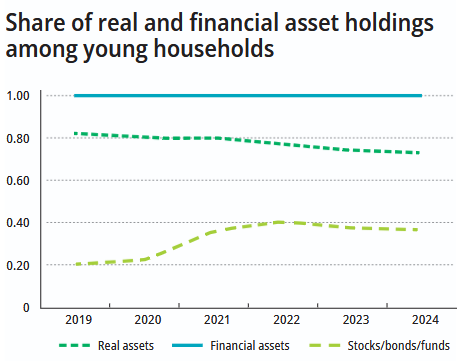
Share of real and financial asset holdings among young households Photo: Korea Capital Market Institute (kcmi.re.kr)
The Risk of Korea’s Investing Boom
As interest in investing rises, concerns about risky trading are also rising. High-risk leveraged investing and “bit-tu” trading have emerged as growing issues among individual 20s and 30s seeking quick profits.
The term bit-tu is a recent neologism combining the Korean words bit (debt) and tuja (investment). It refers to an aggressive form of investment where individuals loan money to invest, often through highly volatile assets such as stocks and cryptocurrencies. While these strategies can generate rapid profits during market rallies, losses can grow just as quickly when markets suddenly fall, leaving inexperienced investors with heavy debt.
According to data from the Financial Supervisory Service on May, the gap with investors who did not use credit loans was noticeable among those in their 20s. The rate of return for those in their twenties was -17.8%, which was 2.7 times higher for debt-to-investor losses compared to -6.7% for accounts that did not use credit loans.
Korea Composite Stock Price Index (KOSPI) is also highly sensitive to geopolitical and global economic uncertainty, especially on March, when KOSPI crashed by 12% due to the conflict between the United States and Iran over the Strait of Hormuz. The strait serves as the passage for roughly 70% of South Korea’s crude oil imports, and Iran’s decision to block foreign shipping sent immediate shockwaves on KOSPI, which relies on certain stocks that deeply depend on that energy supply.
This highlights how quickly and unpredictably the market can change, increasing the possibility of losses for inexperienced investors who react emotionally without fully assessing the risks. Experts warn that enthusiasm for investing without proper risk management can lead to serious long-term consequences. Kim further warned that students treating losses merely as “tuition fees” may encourage gambling-like behavior. “In case of investment loss, the burden of repayment can hinder the economic freedom of young people in the long run,” he explained.
A Smarter Approach to Investing
Kim emphasized two principles for young investors: Risk management and a long-term perspective. Investors should avoid being swayed by short- term price movements and instead evaluate companies over the mid- to long-term, focusing on the company’s fundamentals, such as its performance, growth strategy, and competitiveness. He also emphasized that young investors should refrain from using leverage, adding that installment-style investing can be a more stable approach in a highly volatile market.
Choi Seok-hoon, president of ABS, recommended studying investment with friends and cross-checking each other’s investment methods. Through discussion, peer feedback, and teamwork, students are exposed to a more structured systematic learning environment. He said, “You can gain confidence in your investment by sharing opinions with your friends.”
The growing number of Generation Z investors shows a shift in how young people view financial independence. Stock investment is no longer just a financial activity for some people. Rather, it has become a practical daily strategy for responding to an uncertain future and pursuing economic independence. In today’s volatile market conditions, informed investment decisions based on a long-term perspective are increasingly necessary.
There are no registered comments.
- 1
- 2
- 3
- 4
- 5




I agree to the collection of personal information. [view]