
[Feature] KHU Scholars Revisit Korean Medicine’s Place in Global History
Kyung Hee University (KHU) Communication & Press published Lectures on the History of Traditional Medicine for Korean Medicine on February 27, 2026. The book was written by Professor Cha Woong-seok from the Dept. of Medical History at KHU’s College of Korean Medicine, who also serves as president of the Korean Society for the History of Medicine, and researcher Kim Dong-yul from the Institute of Korean Medical History and Culture at KHU.
The book is the first comprehensive work to integrate the history of Korean medicine with the global history of traditional medicine in a single volume. It acts as an introductory text for beginners while systematically organizing the development and differentiation of East Asian medical traditions.
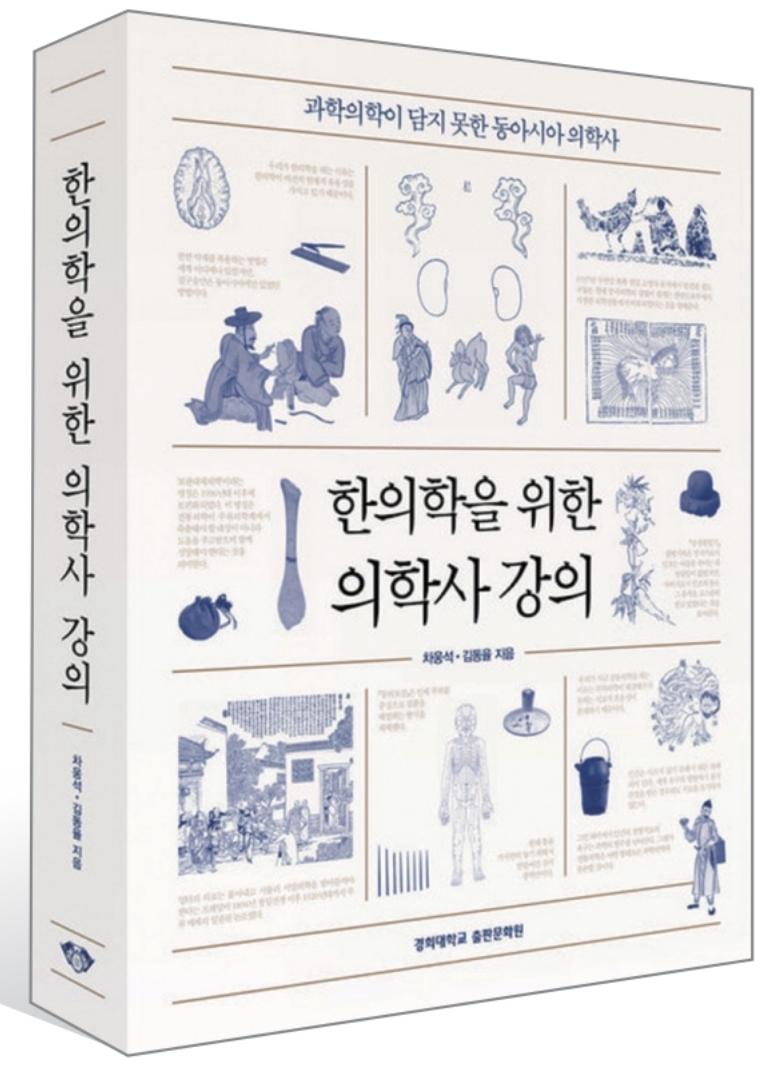
Lectures on the History of Traditional Medicine for Korean Medicine Photo: KHU Communication & Press (khupress.com)
Structure and Summary of the Book
The book is divided into three parts. Part one examines traditional Korean medicine, Part two focuses on traditional Chinese medicine, and Part three surveys representative
traditional medical systems from around the world. By presenting the histories of Korean, Chinese, and global traditions in sequence, the book also summarizes the development of scientific medicine and reexamines the growth of Korean medicine as well as its contemporary significance.
The Motivation and Purpose Behind the Book
The authors define the book as a historical study that explores the meaning of Korean medicine in an era dominated by scientific medicine. In Korea, Korean medicine and Western medicine coexist. However, Western medicine remains the dominant paradigm, which has contributed to the relative undervaluation of Korean medicine. Scientific medicine is often viewed as a force that modernized and challenged Korean medicine, yet it does not resolve all medical problem.
Meaning of Traditional Medicine in the Modern Era
As a distinctive feature, Prof. Cha, speaking on behalf of the authors, describes the book as a kind of storybook. It avoids excessive technical complexity, begins with the Dangun myth and uses folktales and historical narratives to explain the origins and development of Korean medicine in an accessible way. He emphasizes that this is the first all-inclusive history to integrate Korean medicine with global traditional medicine. Studying global traditions alongside Korean medicine is essential—not only for understanding the present but also for considering the future. This approach deepens reader’s understanding of Korean medicine and suggests why the study of traditional medicine remains meaningful in the modern era. When asked whether Korean medicine could continue to develop in a medical landscape largely dominated by Western medicine, Prof. Cha answered positively. He explained that many pathological phenomena still remain unresolved by scientific medicine, and that people continue to seek solutions to these gaps through traditional medicine. For this reason, he argued that the need for traditional medicine persists, making its further development inevitable. Lectures on the History of Traditional Medicine for Korean Medicine offers a comprehensive view on medical history in around Korea. This book reinterprets history not as simple preservation of tradition, but as a dynamic processshaped by continuous interaction with changes in the global medical environment.
There are no registered comments.
I agree to the collection of personal information. [view]