

[Feature] 2026 K-Content: Inside and Outside Perspectives on Hallyu, Redefining K-Culture from Noun to Verb
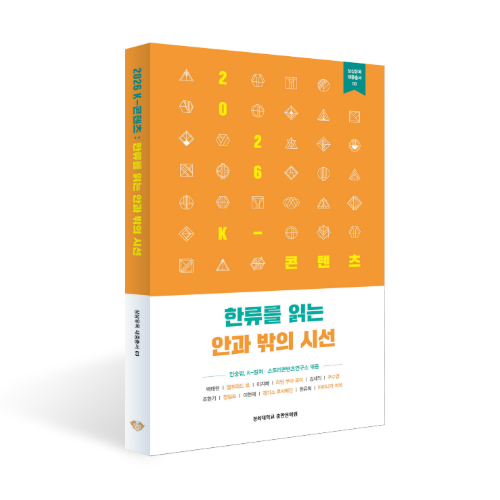
2026 K-Content: Inside and Outside Perspectives on Hallyu
Photo: KHU Communication & Press (khupress.com)
On December 30, 2025, 2026 K-Content: Inside and Outside Perspectives on Hallyu was published by Kyung Hee University(KHU) Communication & Press.
Co-authored by KHU
K-Culture · Story Contents Research Institute and international writers, the
book analyzes the message Hallyu left on the global cultural scene amid the
explosive interest in Korean culture in 2025. It covers six major genres:
drama, film, K-Pop, variety shows, games, and webtoons.
The Current Status of Hallyu through Inside and Outside Eyes
Now that Hallyu has established itself as a mainstream culture
enjoyed globally in the 2020s—having emerged in the 1990s and grown over the
past 30 years—attempts to systematically record this massive flow are
continuing. The KHU K-Culture · Story Contents Research Institute has published
the Inside and Outside
Perspectives on Hallyu
series annually since 2024, making this the third installment. Ahn
Soong-beum, director of the institute, explained the motivation behind the
series: "While having pride as producers and originators of Hallyu is
positive, excessive nationalism, often called ‘guk-ppong,’ can hinder the sustainable expansion of Hallyu." He
added, "The main actors of Hallyu are not just Koreans, but also the individuals outside our
borders who creatively accept and consume it. Therefore, we must include both
inside perspectives from within Korea and outside perspectives from overseas to
grasp the stereoscopic reality of Hallyu."
Director Ahn particularly highlighted the changing meaning of
"K" as a distinguishing feature of the 2026 edition. He explained,
"In the past, we thought K-Content had to be made by Koreans with Korean
capital. However, ‘K’ has now become an ‘empty canvas’ where people participate together and interpret it
in their own ways." This suggests that Hallyu in 2025 and 2026 has entered
a stage of expanding meaning through interaction with the world, rather than functioning
as a unilateral export of Korean culture.
Two Perspectives on “K-Pop Demon Hunters”
The book cross-analyzes hit
works of 2025 across six fields, including the film “K-Pop Demon Hunters,” the
drama “Squid Game,” and the variety show “Culinary Class Wars.” A highlight of
the book is the contrasting perspectives of the two writers regarding “K-Pop
Demon Hunters,” which recorded the highest viewership in Netflix animation
history.
First, Baek Tae-hyun, a researcher
at the institute, offers the inside view. He focuses on the shadow hidden
behind the flashy success. He reads this work not as a simple victory for K-Content,
but as a structural paradox where Hallyu is subordinated to global platform
capital. His critique argues that companies like Netflix merely utilized K-Pop's
fandom culture and emotional labor mechanisms as tools for their own profit
generation.
Conversely, Alfred Lo, a researcher at the University of Oxford,
offers the outside view. He focuses on transboundary characteristics. He
interprets blending of Korean and English languages, the landscape of Seoul,
and global narratives as a process that expands the vitality of Korean culture.
He argues that as foreign audiences engage with Korea through this work, new
symbols capable of global communication are being created rather than
reinforcing a fixed notion of Koreanness.
“K”: From Identity-noun to Co-evolution-verb
Ultimately, the book aims
to reach a clear conclusion through these dual lenses: co-evolution. The
preface declares that “‘K’
is no longer limited to a label denoting the origin of content.” It argues that
“K” must move beyond being an identity-noun that proves a fixed nationality
origin and instead become a co-evolution-verb, where global citizens
communicate, interact, and change together.
Director Ahn emphasized, “Co-evolution
refers to a phenomenon in which elements that previously existed independently
influence each other and dynamically interact. We must abandon the unilateral
view that we produce and sell. Hallyu’s potential becomes much greater when we
understand the process of outsiders creatively appropriating and recontextualizing
it.” In other words, Hallyu in 2026 should be understood as an ongoing movement
that generates meaning across the world, rather than as a fixed entity.
However, the path to co-evolution does not mean simply reproducing
glory. The book suggests that “we need to examine the coldness nearby more
closely than the heat from afar.” This implies learning from the experience of
losing the hearts of neighboring countries like China and Japan—once the
largest consumers of Hallyu—due to an excessive focus on revenue generation. Director
Ahn advised, “If you approach others only as a means of generating profit, you
will inevitably clash” calling for an attitude that recognizes the diplomatic
and industrial tensions hidden behind brilliant achievements. Finally, director
Ahn urged KHU students, who may lead the future K-Content industry, to “abandon
the idea of unilaterally transmitting what is ours, and treat Hallyu as an open
space for negotiation, collision, and dialogue with the world.”
2026 K-Content: Inside and
Outside Perspectives on Hallyu goes beyond a simple trend analysis to propose a direction for
Korean culture. It calls for a rational perception of reality, one that
contemplates expansion in dialogue with the world while confronting the shadows
behind visible success. The book serves as a practical guide for students who
wish to understand the current state of Hallyu objectively while guarding
against vague optimism.
There are no registered comments.
I agree to the collection of personal information. [view]