

[Campus] 2024 Peace BAR Festival Proceeds Towards the Future of Humanity
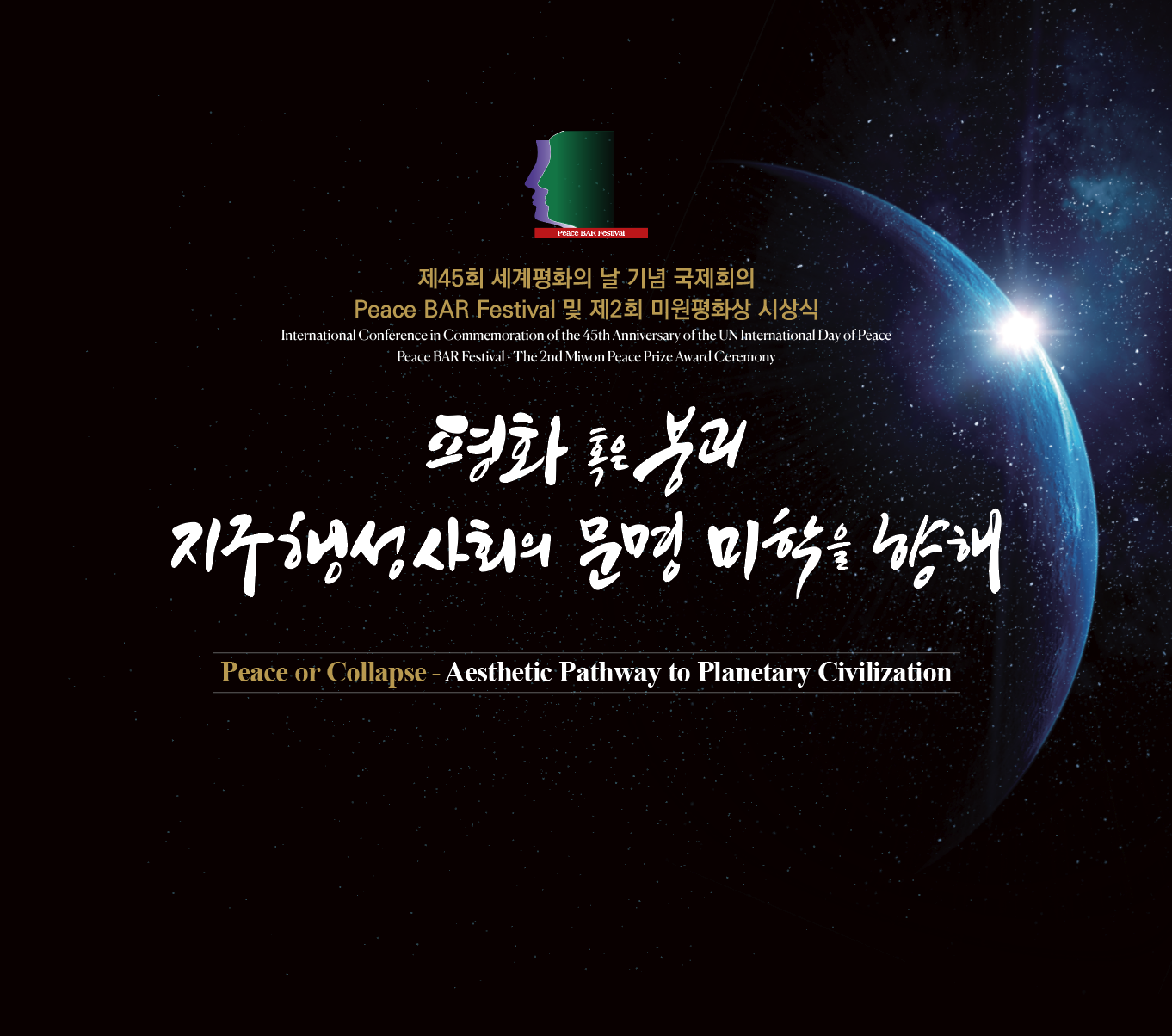
On September 20, Kyung Hee University (KHU) hosted the 2024 Peace BAR Festival at the Grand Peace Hall in Seoul Campus, celebrating International Day of Peace. The theme: The future of humanity, the future of planet earth: in search of our common hope, was set for this year to be discussed with representatives of different countries, civil society organizations, the press, and students.

The panelists discussing climate change and future generations
Background of the Festival
The Peace BAR Festival has been held at KHU every year since the United Nations (UN) established the International Day and Year of Peace. In 1981, KHU proposed the UN International Day and Year of Peace, established and announced unanimously by the 36th United Nations General Assembly held in New York.
Since then, it had been expanding its significance through annual holdings. The festival today is the expansion of the 25th International Symposium to Commemorate the UN International Day of Peace, held from 1982 to 2003. With UN’s approval for UN Peace Park construction plan by KHU, events like cultural arts performances, and forum were combined to become a global peace festival. The word BAR in the name of the festival came from the slogan “Making spiritually Beautiful, materially Affluent, humanly Rewarding global community.”
Event Part One: International Day of Peace Celebration
The International Day of Peace celebration was the first part of the 2024 Peace BAR Festival. It began with an opening speech and guest introduction by Kyung Hee University System (KHUS) President Kim Hyun. Following this, Rector Kim Won-soo of the Global Academy for Future Civilizations delivered a progress report on the establishment of the International Day of Peace and the Miwon Peace Prize. The next was introducing and awarding the first Miwon Peace Prize winner. The prize was made in honor of Choue Young-seek, the former KHU president and founder of the KHUS. The committee for the prize selection consisted of seven world scholars and KHU professors, led by former Director-General of United Nations Educational, Scientific and Cultural Organization (UNESCO), Irina Bokova. She awarded The Elders as an inaugural winner of the prize by a video message with congrats. The Elders is a non-governmental organization (NGO) established by Nelson Mandela, the former president of the Republic of South Africa. Ms. Bokova announced that the NGO was selected for its active engagement in addressing regional conflicts and global challenges, as well as its long careers of dedicated and tireless work with a commitment to comprehensive and universal peace. Afterwards, there was a commemorative speech by Chancellor Choue In-won of the KHUS on the theme of Facing transformative challenges: thoughts on the holistic understanding of our times. The last event was a commemorative music performance, which concluded with Schumann’s piano piece “I Believe”.
Event Part Two: Colloquium
The second part of the festival, the colloquium, is a forum of wisdom where participants discuss various topics to progress toward world peace as global citizens. This year’s colloquium was held under the theme: Revolution of hope for the future generations to live in. The participants discussed Sustainable Development Goals and climate change to enable both future generations, who will be significantly affected by the worsening climate change, and the older generation to recognize the seriousness of climate change and seek solutions.
UN Sustainable Development Solutions Network Korea President Lee Woo-kyun and Director Lee Jeong-mo of the Gwacheon National Science Museum attended, representing civil society organizations and academia, respectively. Two KHU students currently on a UN internship participated as student panelists.
The panelists addressed the severity of climate change and its solutions, exchanging opinions on the Paris Agreement and international discussions related to climate change. The perspectives on climate change were divided between future generations and the older generation, and focused on what actions each generation should take. One side argued that the older generation, having already taken responsibility for climate change and implemented various measures, should bear more responsibility, while the other claimed they should continue to feel responsible nonetheless. Jeon Ji-won, a student of the Dept. of Applied English Linguistics and Translation Studies at KHU, said, "As a future generation, I felt that I need to be an active speaker and demand solutions in order to solve climate issues," after the colloquium.
The Positive Impact of the Festival on Students
Students showed positive responses after participating in the event. Jeon said that she realized personal efforts to solve climate change are not entirely meaningless. "To induce such efforts, it is necessary to address the actual crisis and its negative impact on human society," she said. Yoon Ye-sung, a student of the Dept. of Culture and Entertainment at KHU, remarked, "It was a good festival for those who are interested in the UN and the current situation, especially when there are many ongoing wars." He added, “I observed that in this era of transition where unprecedented crises and opportunities intersect, diverse sectors of society are seeking various measures for future generations, including us."
KHU, which proposed the International Day of Peace, successfully hosted the peace festival to commemorate the anniversary, with an extensive participation. The event had a positive impact on people, raising awareness of peace among participants from various sectors of society. Peace BAR Festival is expected to continue being an agora for people to discuss and practice the value of peace that KHU pursues.
There are no registered comments.
- 1
- 2
- 3
- 4
- 5


I agree to the collection of personal information. [view]