

[Campus] Seoul Campus GSA KnocKH Pledge Review: Addressing Isusues Beyond Pledges
KHU GSA's Pledge Review Series
● Global Campus GSA Core Pledge Review: 50% Fulfillment, Yet Remaining the Tasks for the Future of KHU
With two months left in the Seoul Campus General Student Association (GSA)’s term of office, the three Kyung Hee University (KHU) media outlets─The University Life, Daehak Jubo, and Voice of University Seoul Branch─conducted a review of KnocKH’s pledges.
Elected in the 57th GSA by-election in March, KnocKH presented key pledges such as introducing absolute grading for elective courses. President Eom Gyu-min and Vice-president Heo Ye-dam explained their assessment of these pledges and their plans for the remaining term.

KnocKH at the pledge review meeting
Failure to Introduce Absolute Grading and the Shift Toward Competency-based Evaluation
KnocKH did not deliver on its pledge to introduce absolute grading for general elective courses. Since absolute grading would significantly change the academic system, cooperation with the Global Campus was essential. Eom said, “The Global Campus Humanitas College saw the absolute grading system as a matter that requires cautious and gradual discussion,” indicating the difficulty of implementation.
KnocKH has instead turned its attention toward the competency grading system as a modified approach to the pledge.
“When we asked the University president about absolute grading, he said absolute grading was appropriate, but suggested the competency-based grading system,” Eom said. KnocKH is now exploring this option as a potential substitute.
The competency grading is completely different from the traditional numerical grading, since it evaluates students based on individual competencies. Eom explained, “For example, if a student shows leadership in a group project, their transcript will note that the student has leadership competency.”
Concerns over grading standards have also been raised. The candidate team KHU:EST, running for the 58th GSA election, also pledged to introduce competency grading as the modified version of absolute grading. During press Q&A at the candidate debate, reporters questioned KHU:EST on how qualitative evaluations of individual competencies could be accurately converted into numerical grades.
When asked about how credits would be processed under this system, Eom explained that the evaluating system has not been fully decided yet, stating, “The details still require further discussion.” Eom added, “We believed the current grading system does not align with the educational philosophy of Humanitas College. That is why we selected absolute grading as a key pledge. However, we do not think that absolute grading is the only alternative. If the competency grading system better aligns with the Humanitas College, we are open to introducing it.”
Increased Tuition and Financial Transparency Efforts
After the tuition rise, KHU generated about 11 billion won in additional revenue. This led to heightened student interest in financial transparency. In response, KnocKH pledged to hold regular financial operation briefings and host an Academic Symposium on Finance and Revenue.
The pledge for regular briefings aimed to enhance transparency in how the University spends its budget. On September 25, KnocKH and the Office of Planning & Coordination (OPC) held the briefing. The OPC explained how the additional revenue would be allocated.
Eom stated that another briefing would be held near the end of the second semester to explain next year’s budget.
At the session, the OPC mentioned that further tuition increases for next year were under review. KnocKH responded, “We always try to deliver students’ opinions to the University. So, we are planning to conduct a campus-wide survey to understand how students think about additional tuition increase.” KnocKH also pledged to host the Academic Symposium on Finance and Revenue to explore student-driven revenue models unique to KHU. The first symposium was held on November 11, concluding with awards for selected proposals.
Addressing Issues Beyond Pledges: Festivals, Governance, and Policy Conflicts
KnocKH also commented on several issues that emerged during their term. Regarding the spring festival, they acknowledged operational challenges. “Since we had limited preparation time after the by-election, the festival faced many difficulties, and there were definitely shortcomings,” Eom said. “But through trial and error, we were able to better prepare for the fall festival.”
However, the first day of the fall festival also faced problems, including delayed entry and overnight queuing. Eom said, “There were many issues, but we tried to accept feedback from the first day. What we are most proud of is that we did not just make mistakes—we worked to fix them. We believe the second day of the fall festival went much more smoothly.”
KnocKH also addressed the debate over the possible dissolution of the Student Minority Rights Committee following conflict with the College of Politics & Economics’ student association. The incident raised concerns about unclear bylaws and the absence of checks and balances between student organizations. KnocKH stated that they would begin the process of revising the bylaws. Heo stated, “We plan to operate a task force for bylaw revisions. But specifying the rules for dissolving student organizations in the bylaws could make dissolution overly easy,” saying that such discussions should take place more carefully.
Low Completion Rate but Focus on Long-term Foundations
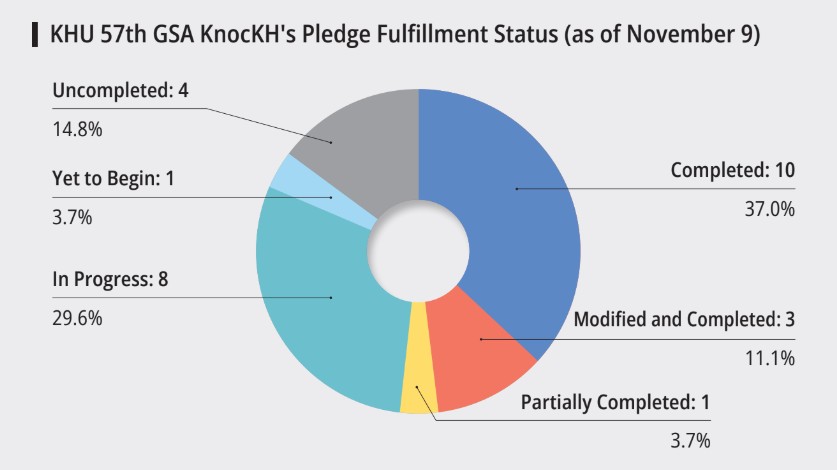
KHU 57th GSA KnocKH’s Pledge Fulfillment Status (as of November 9)
KnocKH’s pledge completion rate remains relatively low. Their internal assessment shows 37% completed, 29.8% in progress, 14.8% uncompleted, 11.1% modified and completed, and 3.7% partially completed and yet to begin. KnocKH acknowledged the low rate but expressed hope that students would evaluate their term based on foundational work rather than numerical completion. Many of their pledges focused on long-term development rather than immediate results. They said, “There are few cases where our pledges were visibly implemented. But we tried to pursue modified implementation whenever possible rather than leaving pledges unfulfilled.”
Among their remaining priorities, KnocKH highlighted establishing a regular meeting body between student representatives and the University vice-president. Heo said, “Since student representatives change every year, discussions have always been fragmented. So, we aim to institutionalize regular meetings to enable more continuous discussions.”
KnocKH also expressed hopes for the next GSA. They said the failure to implement absolute grading for general elective courses was their biggest regret. Heo said, “Absolute grading requires coordination with the Global Campus and involves major academic system changes. We made progress, but implementation was difficult. To realize KHU’s educational philosophy, we hope the next GSA continues to advocate this issue.”
As KnocKH approaches the end of its term, they have shown mixed results—low immediate pledge fulfillment but active efforts to address structural issues and financial transparency. How the next GSA builds upon these efforts will shape the continuity or discontinuity of long-term reforms at KHU.
There are no registered comments.
- 1
- 2
- 3
- 4
- 5



I agree to the collection of personal information. [view]